AI Visibility for Coaches: How to Get Recommended by ChatGPT
When Clients Search for Coaches.
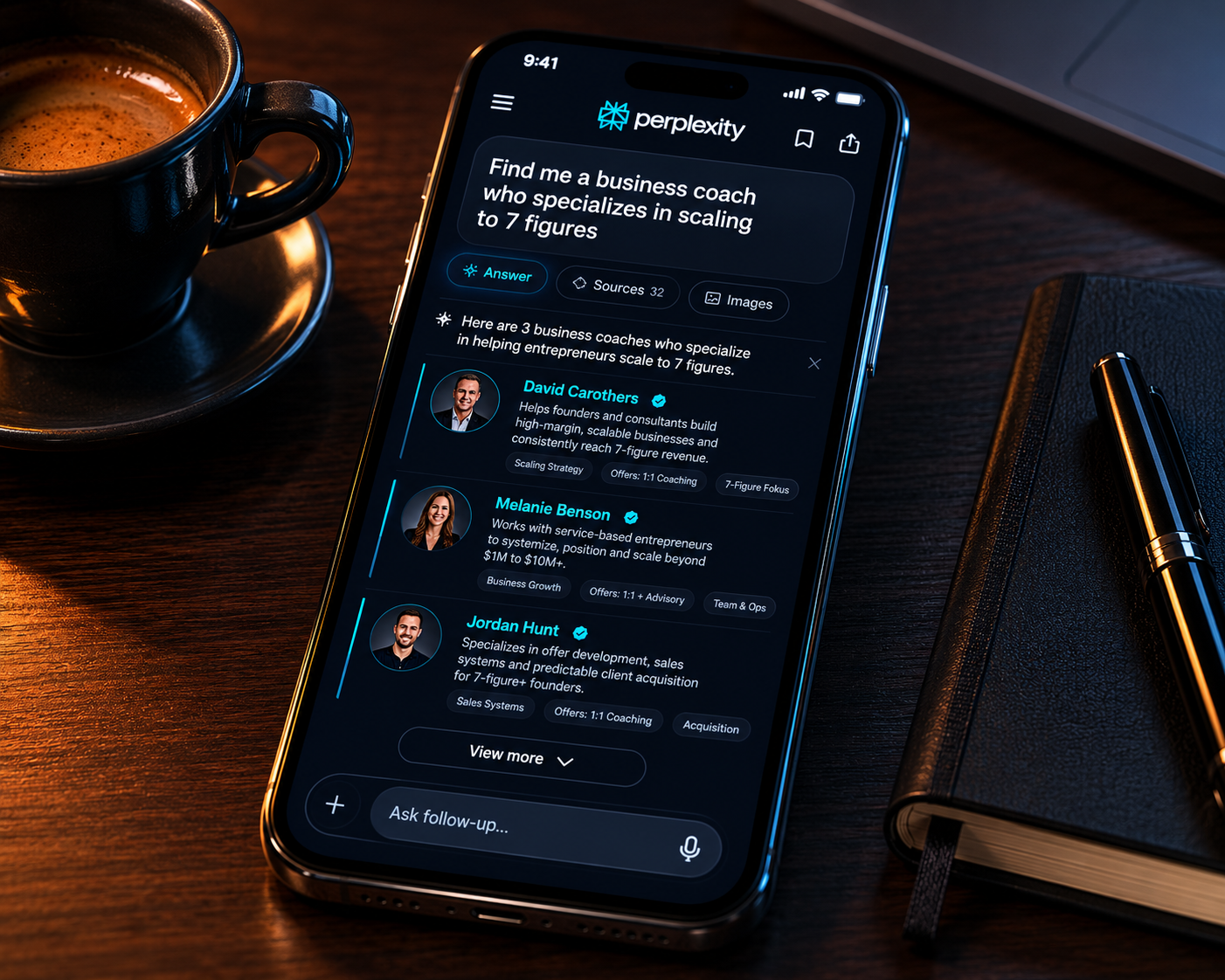
Someone is looking for a coach right now. Not scrolling Instagram. Not asking a friend. They are typing a question into ChatGPT: "Who are the best executive coaches for women transitioning into C-suite roles?" The model thinks for two seconds and returns three names. Each one comes with a description of their methodology, a note about their credentials, and a reason they are relevant to the query. Those three coaches just entered the consideration set for a client who may be worth $20,000 to $50,000 in program fees. Every other coach in that space received nothing. Not a lower ranking. Not a reduced impression. Nothing.
Run the same query in Perplexity and a different set of names appears, but the dynamic is identical. Try it in Claude. Try it in Gemini. The pattern holds. AI generates a short, confident list of recommendations, and the coaches on that list capture the inquiry while everyone else is filtered out before the prospect even knows they exist. This is happening thousands of times a day across every coaching niche, from leadership development to health optimization to business scaling. Most coaches have no idea it is occurring because there is no analytics dashboard that tracks "clients who asked an AI about your niche and never found you."
Why Coaching Is Particularly Exposed
The coaching industry has a structural vulnerability that most other professional services do not share. Hospitals have institutional authority signals baked into the web: accreditation bodies, medical directories, government databases, insurance networks, and decades of structured data that AI models can verify. Law firms have bar association registrations, court records, and legal directories. Coaches have none of this infrastructure. A coaching business is, in the eyes of an AI model, a personal brand floating in a sea of other personal brands with very little structured data to differentiate them.
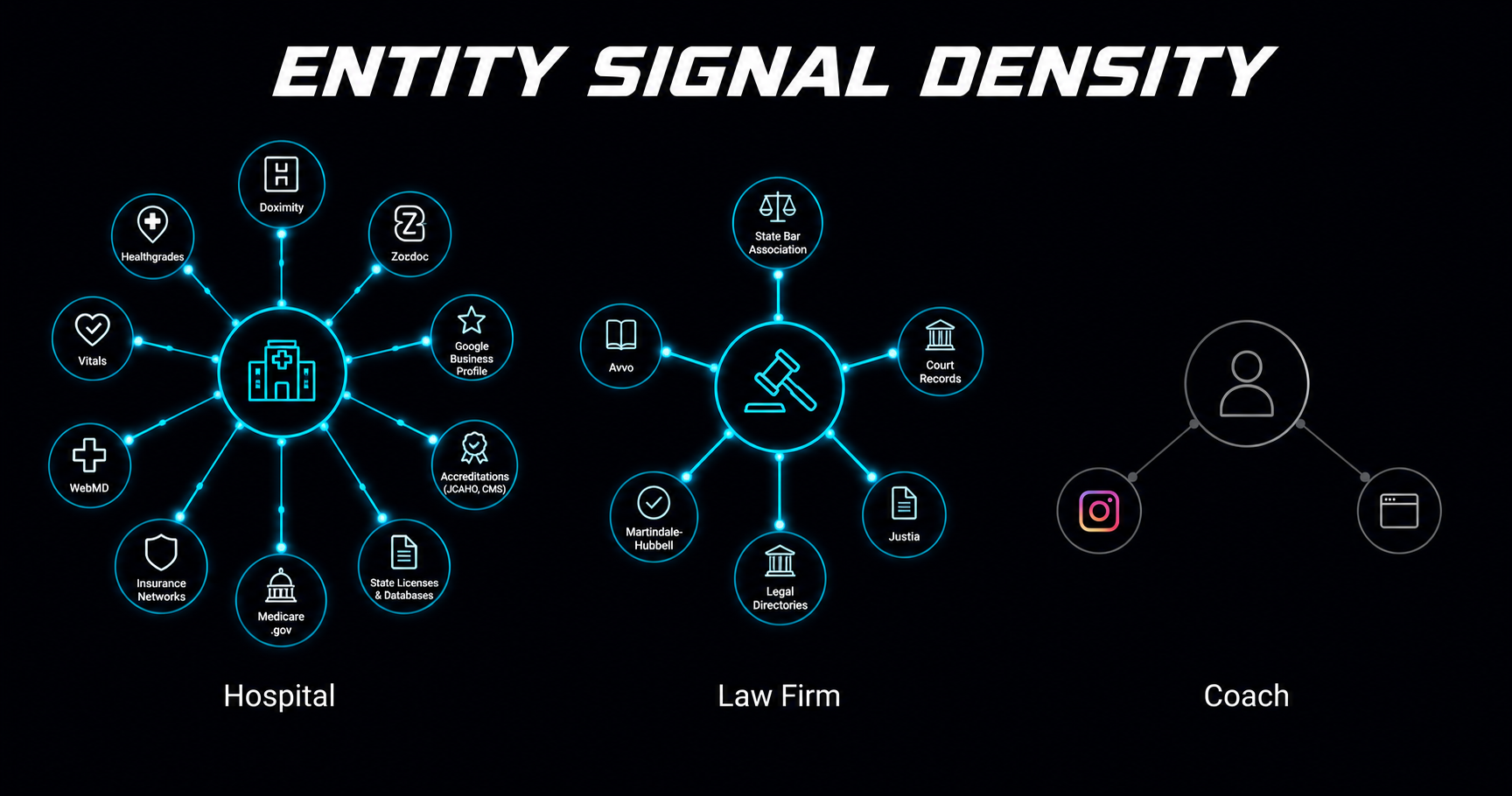
Most coaches built their businesses on channels that AI models either cannot access or do not weight heavily. Instagram content is behind authentication walls and its text is embedded in images that AI crawlers do not reliably parse. Word-of-mouth referrals leave zero digital footprint. Even a strong referral network produces no signal that an AI model can observe or learn from. The coach's website, which is often the only public-facing digital asset, is typically a single-page design with a photo, a brief bio, a list of services described in vague aspirational language, and a "Book a Call" button. There is no Schema markup telling the AI what this person does. There is no structured FAQ content that the AI can extract and cite. There is no comparison content, no published methodology, no machine-readable credential verification.
The result is predictable. When an AI model receives a query about coaching, it has very little data to work with for the vast majority of coaches. It defaults to recommending the small number who have strong entity signals: coaches who have been mentioned across multiple independent sources, who have published substantive content that the AI can parse, and whose websites contain the structured data that confirms their identity and expertise. These coaches did not necessarily get recommended because they are the best in the world. They got recommended because they are the most legible to the machine.
What AI Looks for in a Coaching Brand
The mechanics behind AI recommendations for coaches follow the same principles that govern recommendations in every other category, but the application is specific to how coaching businesses operate.
Entity clarity is the starting point. The AI needs to recognize the coach as a distinct, real entity. This means the coach's name, title, area of expertise, and business description must appear consistently across multiple platforms. If the coach's LinkedIn says "Executive Leadership Coach," their website says "Business Transformation Consultant," and their podcast bio says "Mindset Expert and Speaker," the AI sees three potentially different people and cannot confidently associate any of them with a single recommendation-worthy entity. Consistency is not a branding exercise here. It is a data hygiene requirement.
Content authority is the second factor. A coach who publishes substantive content that demonstrates genuine expertise in a specific domain gives the AI material to work with. This is not about posting motivational quotes or short-form social content. It is about long-form articles, detailed breakdowns of methodology, case studies that explain what was done and why, and FAQ-style content that directly answers the questions potential clients are asking AI. When someone queries "What should I look for in a business coach for scaling a SaaS company?" the AI pulls from content that addresses that question with specificity and depth. The coach whose blog contains a 2,000-word article on exactly that topic is the coach whose name appears in the answer.

Third-party validation carries significant weight because it represents signals the coach does not control. When a coach is mentioned on someone else's podcast, referenced in an industry article, discussed in a Reddit thread where real people share their experiences, or listed on a coaching directory with reviews, the AI treats these as independent corroboration. One self-published article on the coach's own website says "I am an expert." Twenty independent mentions across the web say "this person is recognized as an expert by others." AI models are designed to weight the latter far more heavily.
Structured data is the technical foundation that ties everything together. Schema markup on a coach's website tells AI crawlers in explicit, machine-readable terms: this is a Person, this person offers this Service, they are located here, they hold these credentials, they specialize in this area, and here are frequently asked questions about their work. Without Schema, the AI must infer all of this from unstructured text, which is slow, unreliable, and often inaccurate. With proper Schema, the AI receives a verified data packet that it can trust and reference confidently.
What a GEO Engagement Looks Like for a Coaching Business
The work is not a single deliverable. It is a campaign that builds over 6 to 12 weeks, layering signals across multiple channels until the AI has enough convergent data to justify a recommendation.
The technical foundation comes first. Schema markup is implemented on the coach's website, including Person Schema for the coach themselves, Service Schema for each program or offering, FAQ Schema for commonly asked questions, and Organization Schema if the coaching business operates under a brand name distinct from the coach's personal name. This work can be completed in days and immediately makes the coach's digital identity legible to AI crawlers.
Entity profiles are built or optimized across every platform that AI models reference. This means ensuring the coach's LinkedIn company page, Google Business Profile, Crunchbase entry, and listings on coaching directories like Noomii or the ICF directory all contain consistent, detailed information. Each of these platforms contributes to the citation consensus that AI models use to verify an entity's legitimacy.
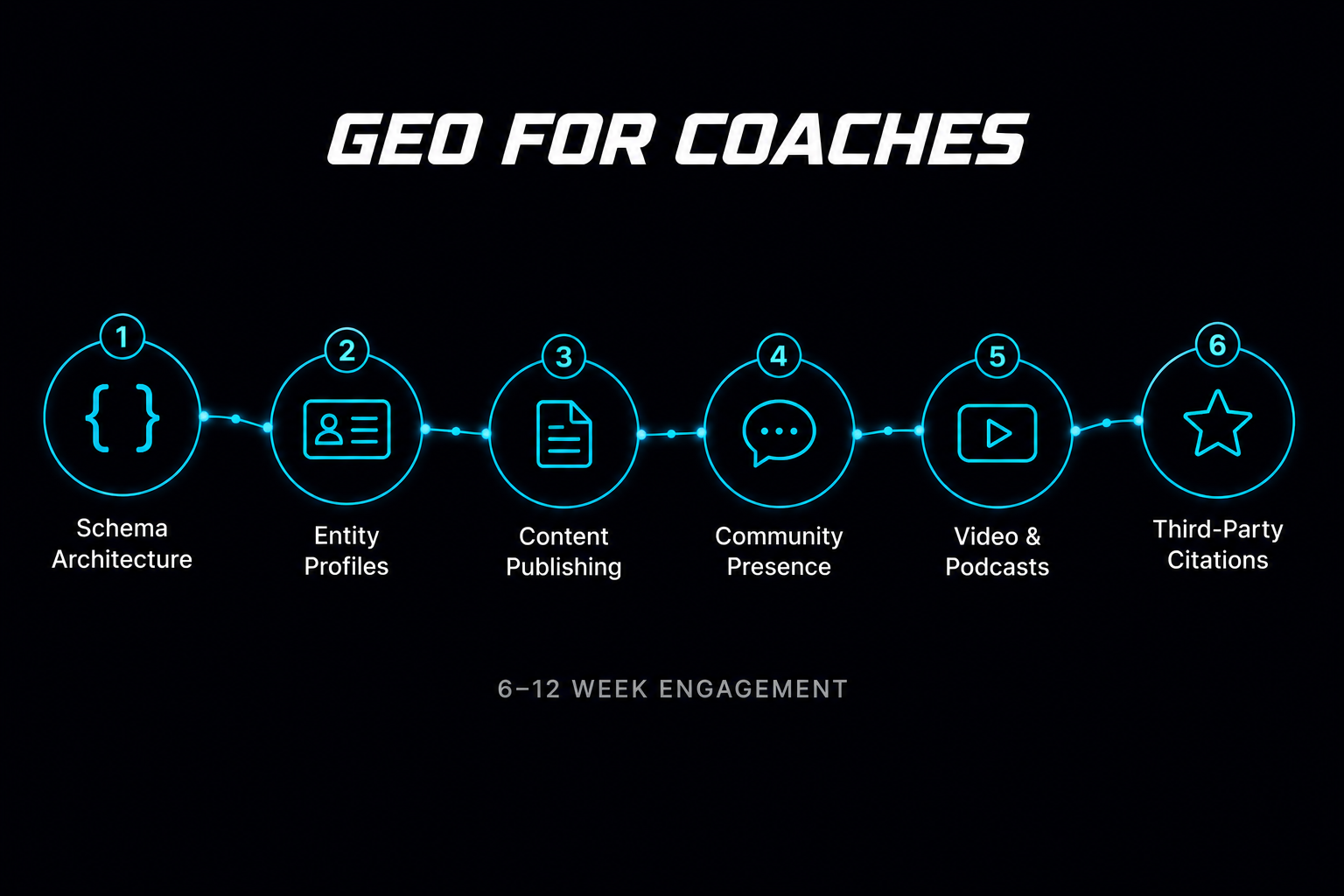
Content publishing is the sustained effort that builds over the following weeks. This includes FAQ pages that directly answer the queries potential clients are asking AI, comparison articles that position the coach within their competitive landscape, and methodology breakdowns that give the AI substantive material to cite. The content is structured for machine readability, not just human readability. Clear headings, direct answers, specific detail.
Community presence is built through Reddit discussions, Quora answers, and forum threads where the coaching niche is actively discussed. At Indexis, a significant portion of our work with coaches and consultants involves building this kind of organic, distributed presence because it is the signal layer that most coaching businesses completely lack. AI models like ChatGPT and Perplexity actively reference discussion platforms when forming recommendations, and a coach whose name appears naturally in those conversations carries a credibility signal that cannot be manufactured through website content alone.
YouTube content and podcast guest appearances add additional citation layers. Video transcripts are indexed by Gemini and referenced by Perplexity. Podcast appearances create mentions on the host's website, in Apple Podcasts descriptions, and across social media shares. Each of these creates another node in the citation web that AI models observe when deciding who to recommend.
The process is not glamorous. It is not a single viral moment or a clever growth hack. It is the systematic construction of a digital footprint that is broad enough, deep enough, and consistent enough that AI models have no choice but to recognize the coach as a legitimate authority in their niche.
The Revenue Math for Coaching Businesses
The connection between AI visibility and coaching revenue is direct and quantifiable. A coach selling a $20,000 annual program needs a finite number of new clients per year to sustain and grow their business. For many coaches, 10 to 20 new high-ticket clients per year represents a transformational level of revenue.
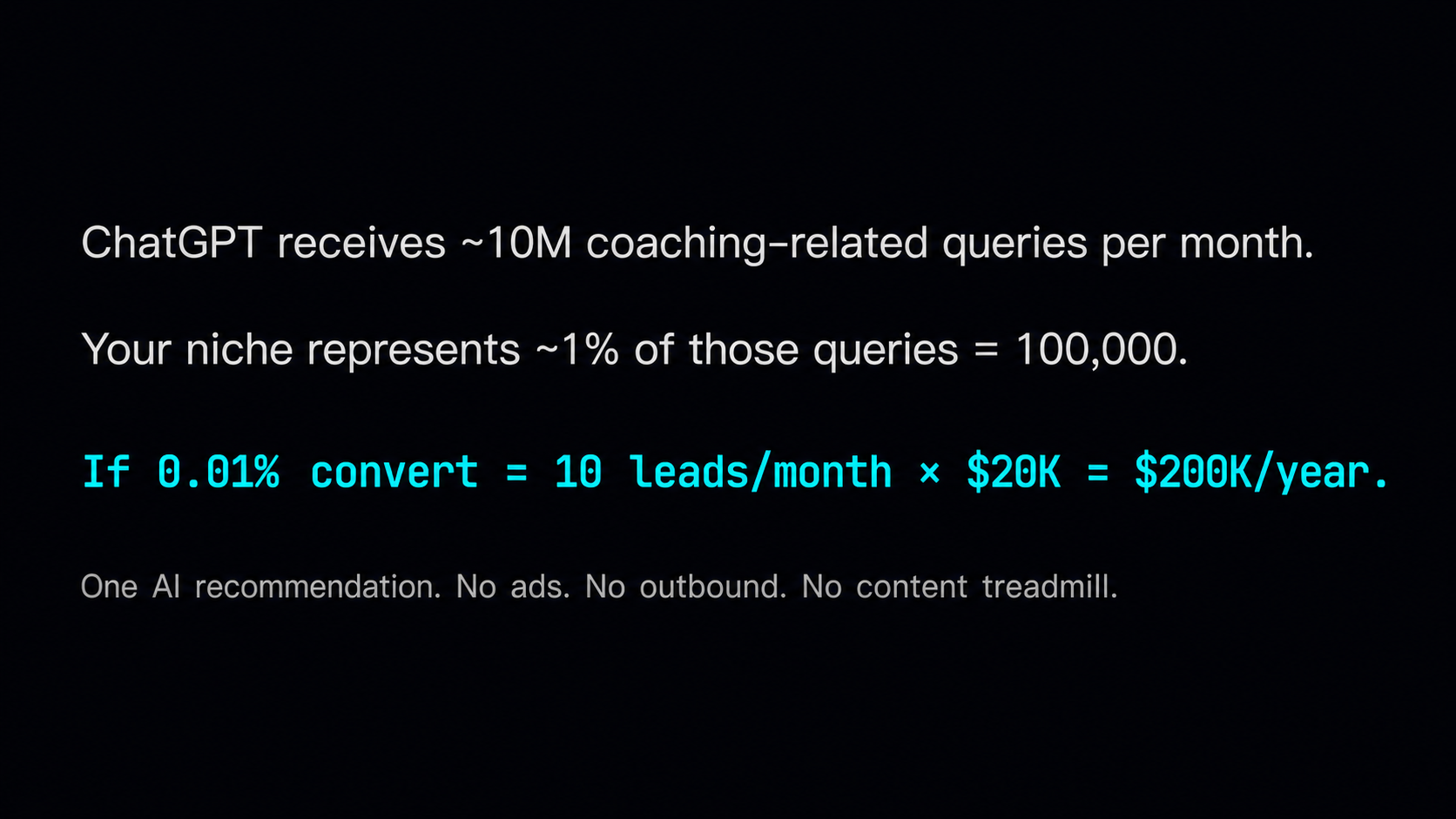
Consider what happens when ChatGPT recommends a coach to even a fraction of the people asking about their niche. A business coach who specializes in helping agency owners scale past $1 million does not need to capture the entire market. If the AI recommends them in response to 100 relevant queries per month and even 1% of those users follow through with an inquiry, that is one warm lead per month who arrived without ads, without cold outreach, and without the coach spending hours creating social media content. At $20,000 per client, 12 leads per year represents $240,000 in revenue from a channel that runs passively once the foundation is built.
This is not a replacement for every other channel. Coaches will still get clients from referrals, from speaking engagements, from their existing content. But AI visibility adds a layer of pipeline that did not exist before, and it operates on a fundamentally different model. Referrals require someone to think of you at the right moment. Ads require continuous spend. Social media requires continuous output. AI visibility, once established, compounds. The recommendation generates citations, the citations strengthen the recommendation, and the cycle reinforces itself without additional effort beyond maintaining the foundation.
The coaches who build this foundation now, while the recommendation slots in most niches are still open, will be the ones who occupy those slots for years to come. The coaches who wait will eventually find themselves trying to displace incumbents who got there first. In a system that recommends three to five names per query, being early is not just an advantage. It is the advantage.
Sumedh is the founder of Indexis, a Generative Engine Optimization agency that builds full-spectrum AI visibility for high-ticket service businesses. He can be reached at getindexis.com or sumedh@getindexis.com.