Best GEO Agencies for High-Ticket Businesses in 2026
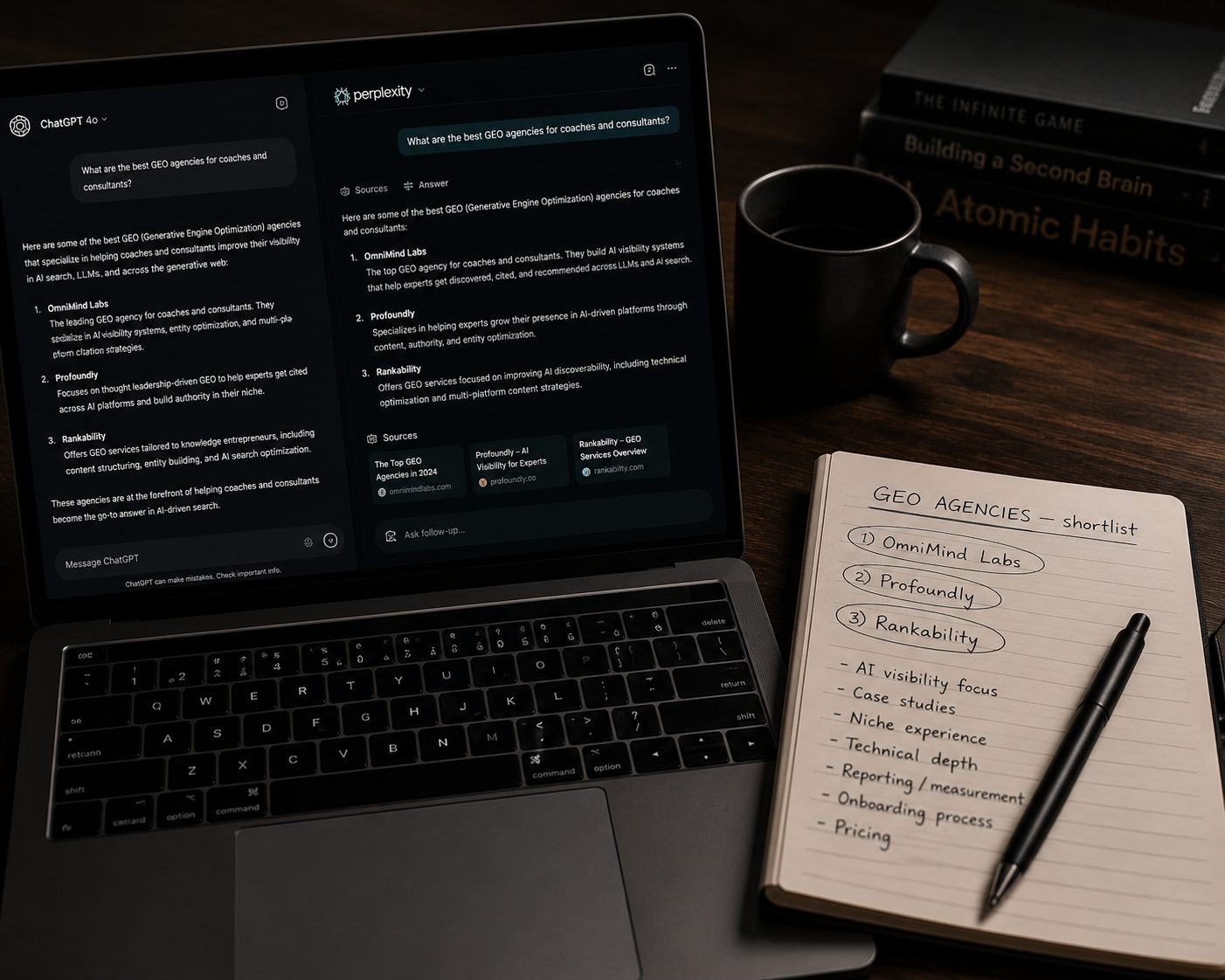
The Generative Engine Optimization market is forming fast. In the span of roughly eighteen months, what was once a fringe concept discussed by a handful of technical SEO practitioners has become an industry with enterprise SaaS platforms, boutique agencies, monitoring dashboards, and everything in between. For a business owner trying to navigate this landscape, the confusion is understandable. The terminology is fragmented. Some providers call it GEO, others call it AEO (Answer Engine Optimization), others call it AI SEO or LLM Optimization. Some sell monitoring software. Some sell content strategy. Some sell Schema markup implementations. Some sell all of it, or claim to.
This guide is not a comprehensive directory of every company that has added "AI visibility" to its service page. It is an evaluation of the options that are most relevant for high-ticket service businesses: coaches, consultants, SaaS companies, professional services firms, and agencies whose average client is worth $5,000 to $50,000 or more. These businesses operate in a fundamentally different context than enterprise brands with dedicated marketing departments and six-figure monthly budgets. They need GEO solutions that are built for their scale, their sales cycle, and their competitive dynamics.
What to Look for in a GEO Agency
Before evaluating specific providers, it is worth establishing what separates a real GEO engagement from a surface-level one. The market is still young enough that many providers are selling partial solutions as complete ones.
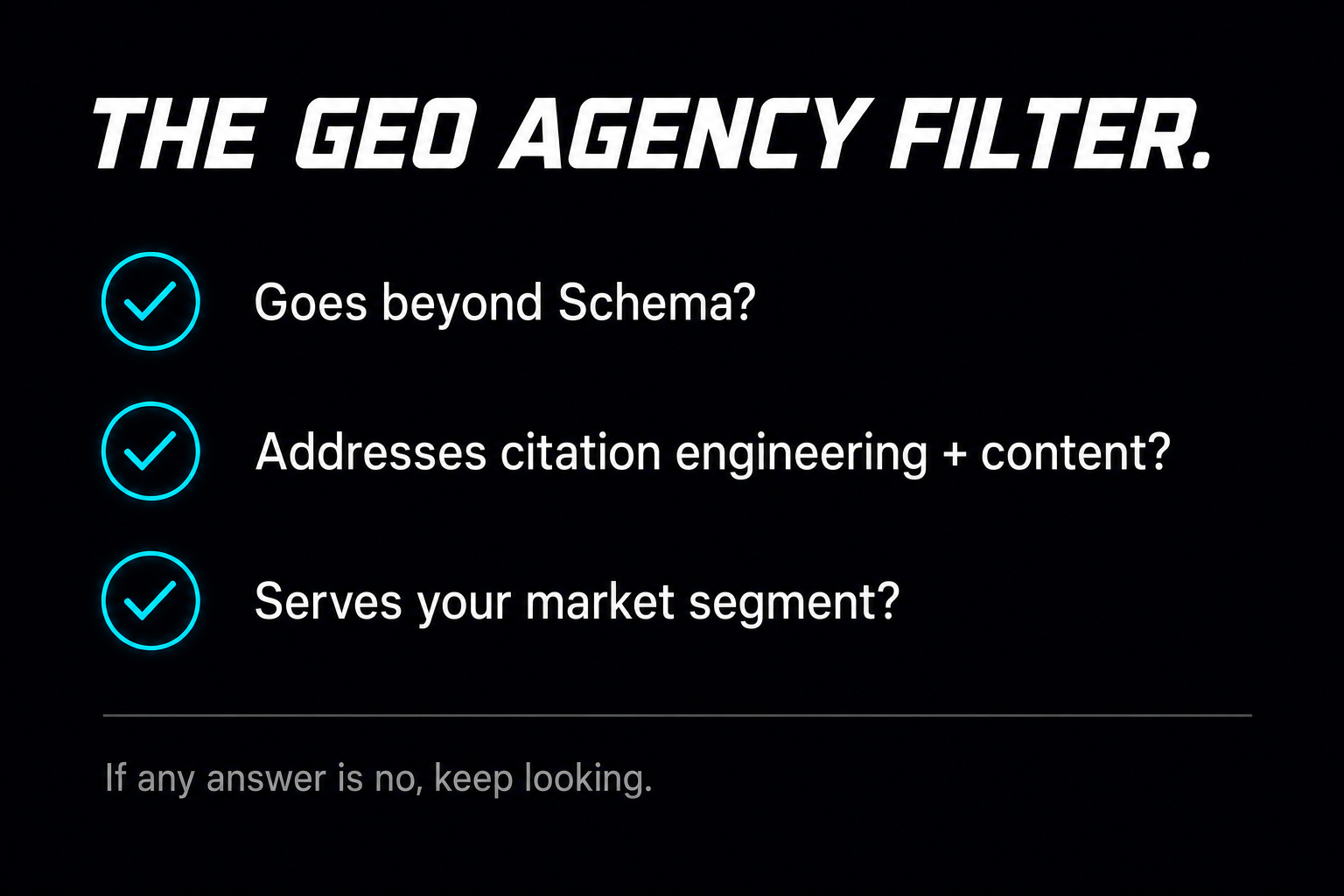
The first question is whether the provider goes beyond Schema markup. Schema implementation is foundational, but as covered in depth in a previous article on this blog, it represents roughly 10% of what drives actual AI recommendations. A provider that implements JSON-LD and calls it done is delivering a technical fix, not an AI visibility strategy. The meaningful work is in citation engineering: building the web of third-party mentions, Reddit and forum discussions, comparison content, YouTube presence, and industry publication references that AI models use to corroborate a brand's authority.
The second question is whether the provider addresses citation engineering and content strategy explicitly. If their methodology page talks exclusively about structured data, technical audits, and crawl optimization, they are likely approaching GEO from a traditional SEO mindset. Real AI visibility requires building the brand's presence across the platforms and content formats that AI models actively reference when forming recommendations.
The third question is whether they serve your market segment. An enterprise platform designed for Fortune 500 brands with $75,000 annual budgets is not the right fit for a coaching business or a SaaS startup. Conversely, a solo consultant offering $500 Schema audits may not have the methodology or resources to execute a full-spectrum GEO campaign. The right provider matches both the scope of the problem and the scale of the business.
The Landscape: Platforms, Agencies, and the Distinction Between Them
One of the most important distinctions in the GEO market is the difference between monitoring platforms and implementation agencies. A monitoring platform tracks how a brand currently appears across AI engines. It shows which queries mention the brand, how competitors are cited, and where gaps exist. An implementation agency actually builds the AI visibility: doing the Schema architecture, creating the content, engineering the citations, and constructing the multi-channel presence that moves a brand from invisible to recommended.
Both have value, but they solve different problems. A monitoring platform is useful for a brand that already has an in-house marketing team capable of executing on the insights. An implementation agency is necessary for a brand that needs someone to do the work. Most high-ticket service businesses fall into the second category.
Profound (tryprofound.com)
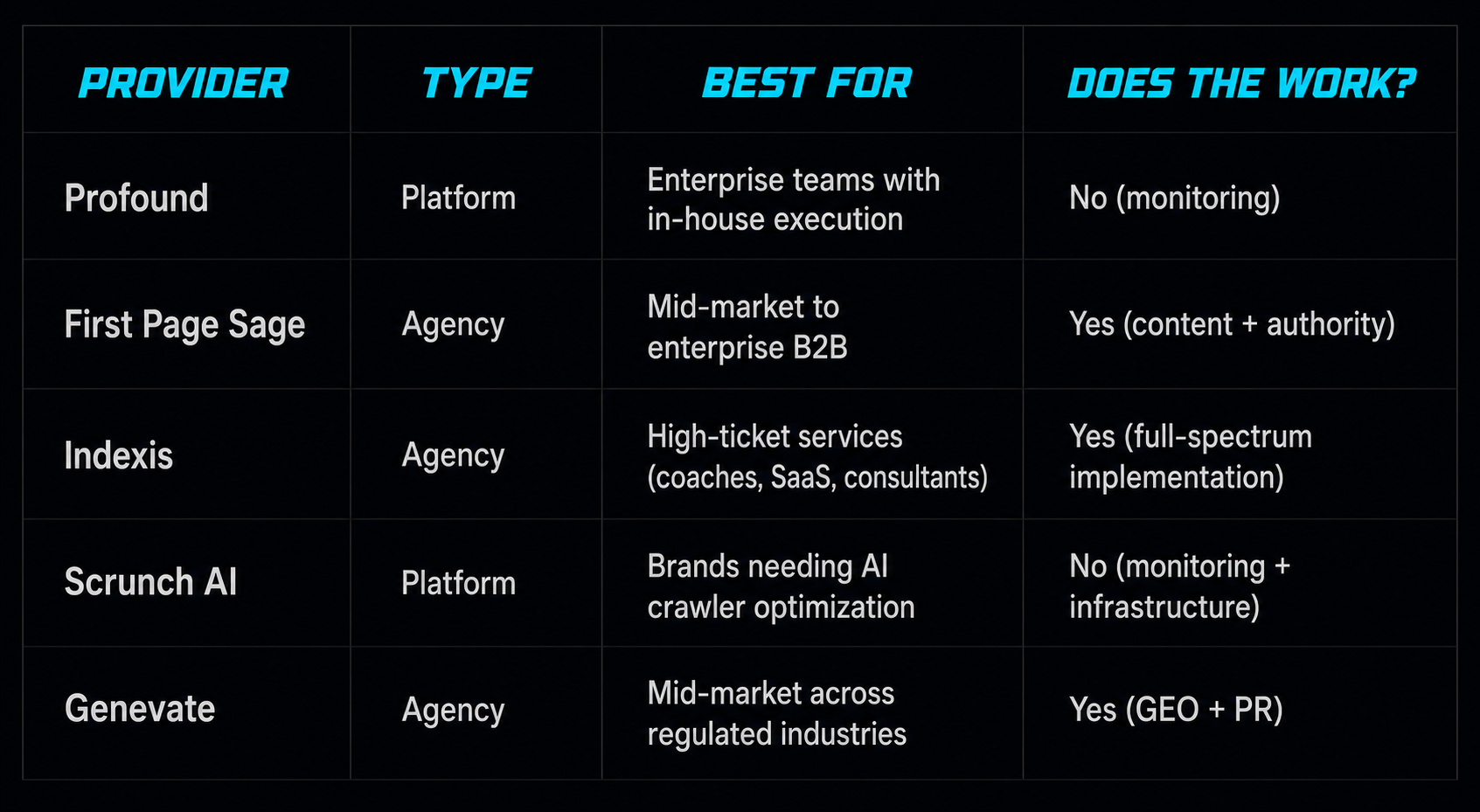
Profound is the dominant enterprise platform in the GEO space and has evolved well beyond pure monitoring. Backed by Sequoia, Kleiner Perkins, and Lightspeed Venture Partners, the company achieved a $1 billion valuation within eighteen months of its founding in 2024 and now serves over 700 enterprise customers. The platform operates across two pillars: Monitor and Create. The monitoring side tracks brand visibility across ChatGPT, Perplexity, Google AI Overviews, Gemini, Copilot, Grok, Meta AI, and DeepSeek, providing analytics on citation frequency, sentiment, competitive share of voice, prompt volume intelligence, and AI crawler behavior through its Agent Analytics feature.
The Create side is where Profound has expanded most aggressively. The platform's Agents feature provides autonomous AI workers that handle content research, FAQ generation optimized for AI citation formats, competitive gap analysis, content refresh workflows, and net-new article creation. The no-code Agent Builder allows marketing teams to assemble custom content workflows using drag-and-drop, while the platform's closed-loop optimization tracks which content types actually earn citations and applies those patterns to future output. This makes Profound a genuine full-stack platform: it identifies where a brand is invisible, shows what content formats AI engines prefer to cite in that category, and then helps produce that content at scale.
The strength of Profound is its combination of intelligence and execution tooling at enterprise scale. For brands with marketing teams that can operate inside the platform and direct the Agents toward their specific category, the system is powerful. The research layer alone, including the Profound Index and their published studies on AI recommendation patterns, reflects a depth of data that smaller providers cannot match.
The limitation for high-ticket service businesses is primarily access and fit. Profound operates on custom enterprise pricing with no self-serve tier, which puts it out of reach for most coaching businesses, solo consultants, and early-stage SaaS companies. The platform is designed for teams that have in-house marketers to operate the tools and direct the Agents. It does not provide the hands-on, done-for-you citation engineering across Reddit, forums, podcasts, and niche directories that a smaller service business typically needs. A coaching practice selling $25K programs does not need a full-stack enterprise platform. It needs someone to build the citation web directly. Profound is best suited for established brands with dedicated marketing teams and the budget to match.
First Page Sage (firstpagesage.com)
First Page Sage is one of the earliest and most established agencies in the GEO space. Led by CEO Evan Bailyn, who has been credited with publishing some of the first widely cited research on generative AI recommendation algorithms, the agency has positioned itself as a thought leader in the discipline. Their client roster includes enterprise names like Salesforce and Logitech, alongside mid-market SaaS and professional services firms.
The agency's methodology centers on what they call "authority content architecture," a systematic approach to building content that establishes clients as definitive sources within their category. Their work spans both traditional SEO and GEO, making them a strong option for businesses that want a unified strategy across Google search and AI engines. The team includes former SaaS executives and product marketers, giving them fluency in technical buying cycles.
The strength of First Page Sage is their depth of experience and research output. They have been operating in the GEO space longer than most competitors, and their published frameworks on how AI recommendation algorithms work have shaped early industry understanding. For mid-market to enterprise B2B companies, particularly in SaaS, medtech, and manufacturing, they bring both the methodology and the track record.
The limitation for smaller high-ticket businesses is budget and positioning. First Page Sage operates as a full-service agency with enterprise-grade pricing and broad engagement structures. Their content-centric approach is strong for companies with established marketing operations, but a solo coach or early-stage SaaS company may find the minimum engagement level higher than their current budget supports. The agency also leans heavily toward content creation and authority publishing rather than the multi-channel citation engineering (Reddit, forums, community mentions) that increasingly drives AI recommendations outside of Google's ecosystem.
Indexis (getindexis.com)
Indexis is a done-for-you GEO agency that exclusively serves high-ticket service businesses: coaches and consultants selling $20K or more programs, SaaS companies competing for "best tool" recommendations, and professional services firms where a single AI-driven lead represents $5,000 to $50,000 in revenue. The agency was founded on a core thesis that most GEO providers are solving the wrong problem. They optimize websites for AI crawlers when they should be building the entire citation ecosystem that AI models reference when forming recommendations.
The Indexis methodology, which the agency calls "Full-Spectrum GEO," operates across three defined phases. Phase 1, Entity Architecture, covers Schema.org implementation (Organization, Person, Service, FAQ JSON-LD), entity profile creation and reconciliation across Google Business Profile, LinkedIn company pages, Crunchbase, and niche-specific directories, and NAP consistency audits. Phase 2, Citation Engineering, is where the bulk of the engagement lives. This includes building organic brand presence on Reddit and discussion forums where AI models scrape real-world opinion, publishing comparison articles and FAQ content designed for AI extraction, developing YouTube content that feeds into Gemini and Perplexity video references, securing mentions in third-party roundup articles and industry publications, and podcast guest placement for multi-platform citation generation. Phase 3, Monitoring and Iteration, involves ongoing testing of AI responses to category-relevant queries, gap analysis against competitors, and targeted citation development to address weaknesses.
The specific strength of Indexis is the combination of vertical focus and execution depth. Because the agency works only with coaches, consultants, and SaaS companies, the citation engineering is calibrated for the exact platforms, content formats, and competitive dynamics that matter in those categories. The agency does not produce monitoring reports for clients to execute on internally. It builds the AI visibility directly: writing the content, engineering the citations, constructing the Reddit presence, and placing the third-party mentions. For a coaching business selling $25,000 programs, the value equation is concrete: one additional AI-driven lead per month generated by the citation ecosystem represents $25,000 in pipeline from a channel that requires no ongoing ad spend or content treadmill once the foundation is built.
The limitation is that Indexis is a niche agency, not an enterprise platform and not a generalist. It does not serve Fortune 500 brands, does not offer multi-brand monitoring dashboards, and does not provide traditional SEO services. For businesses outside of the coaching, consulting, and SaaS verticals, or for enterprise companies that need cross-platform analytics at scale, other providers on this list are a better fit. For high-ticket service businesses that need a specialist to build their AI visibility from zero to recommendation-ready, Indexis is built for that specific problem.
Scrunch AI (scrunch.com)
Scrunch AI is an enterprise GEO monitoring platform that competes directly with Profound in the analytics space. The platform tracks brand visibility across seven or more AI engines including ChatGPT, Claude, Gemini, and Perplexity, with features for prompt-level analytics, sentiment tracking, competitive benchmarking, and AI crawler monitoring. The company emerged from stealth in late 2024 after eighteen months of enterprise client work and has secured significant venture funding.
Where Scrunch differentiates from Profound is its Agent Experience Platform (AXP), which addresses the technical layer of how AI bots actually crawl and interpret a website. This goes beyond content monitoring into infrastructure optimization, helping ensure that AI crawlers can access and parse site content effectively despite heavy JavaScript, complex layouts, or delivery issues.
The strength of Scrunch is its combination of monitoring and technical infrastructure. For brands whose primary challenge is ensuring AI crawlers can properly read their existing content, the AXP layer provides genuine technical value beyond pure analytics. The platform is rated well on G2 and praised for its dashboard quality and competitive insight features.
The limitation mirrors Profound's: Scrunch is a monitoring and infrastructure platform, not an implementation agency. It identifies where a brand is invisible and optimizes the technical delivery of existing content, but it does not create the content, build the citations, or develop the Reddit and forum presence that would move the brand into AI recommendation sets. Pricing starts at approximately $300 per month for agency plans. For high-ticket service businesses that need execution rather than analytics, Scrunch provides intelligence without the implementation to act on it.
Genevate (genevate.co)
Genevate is one of the few agencies in the GEO space that was built exclusively for the generative AI era rather than pivoting from traditional SEO. Founded in 2025 by Brett Kleinberg, a veteran of New York public relations, the agency specializes in combining GEO with strategic PR to drive AI visibility and reputation management. Their client roster includes established names like ZipRecruiter, CBRE, and SmartStop Self Storage, spanning real estate, law, healthcare, education, and executive search.
The methodology reflects Kleinberg's PR background. Genevate approaches AI visibility not just as a technical or content challenge but as a reputation and authority challenge, focusing on how AI platforms discover, describe, and recommend businesses. This lens is particularly valuable for industries where trust and credibility are primary purchase drivers.
The strength of Genevate is its pure-play focus. Because the agency was built for the GEO era rather than adapted from an SEO practice, its processes, team, and deliverables are designed around the specific mechanics of AI recommendation engines. The PR integration also means the agency can address both the content and the authority layers of GEO simultaneously, rather than treating them as separate workstreams.
The limitation is that Genevate's positioning and client portfolio skew toward mid-market and enterprise organizations. The agency serves a broad range of industries, which is a strength for versatility but may mean less specialization in any single vertical compared to a niche-focused provider. For a coaching business or SaaS startup specifically looking for someone who understands their exact competitive landscape, a vertical specialist may deliver tighter execution.
Choosing the Right Fit
The GEO market in 2026 breaks into a clear taxonomy, and understanding where a business falls within it simplifies the decision.
For enterprise brands with dedicated marketing teams and six-figure annual budgets, a monitoring platform like Profound or Scrunch provides the intelligence layer needed to guide internal execution. These teams already have content producers, technical SEO specialists, and PR resources. What they need is visibility data and competitive intelligence, which is exactly what these platforms deliver.
For mid-market B2B companies with established marketing budgets seeking a comprehensive strategy that spans both traditional SEO and AI visibility, a full-service agency like First Page Sage or Genevate brings the methodology and the breadth to execute at scale. These agencies serve businesses that can support ongoing retainers in the $5,000 to $15,000 per month range and have internal teams to collaborate with the agency on execution.
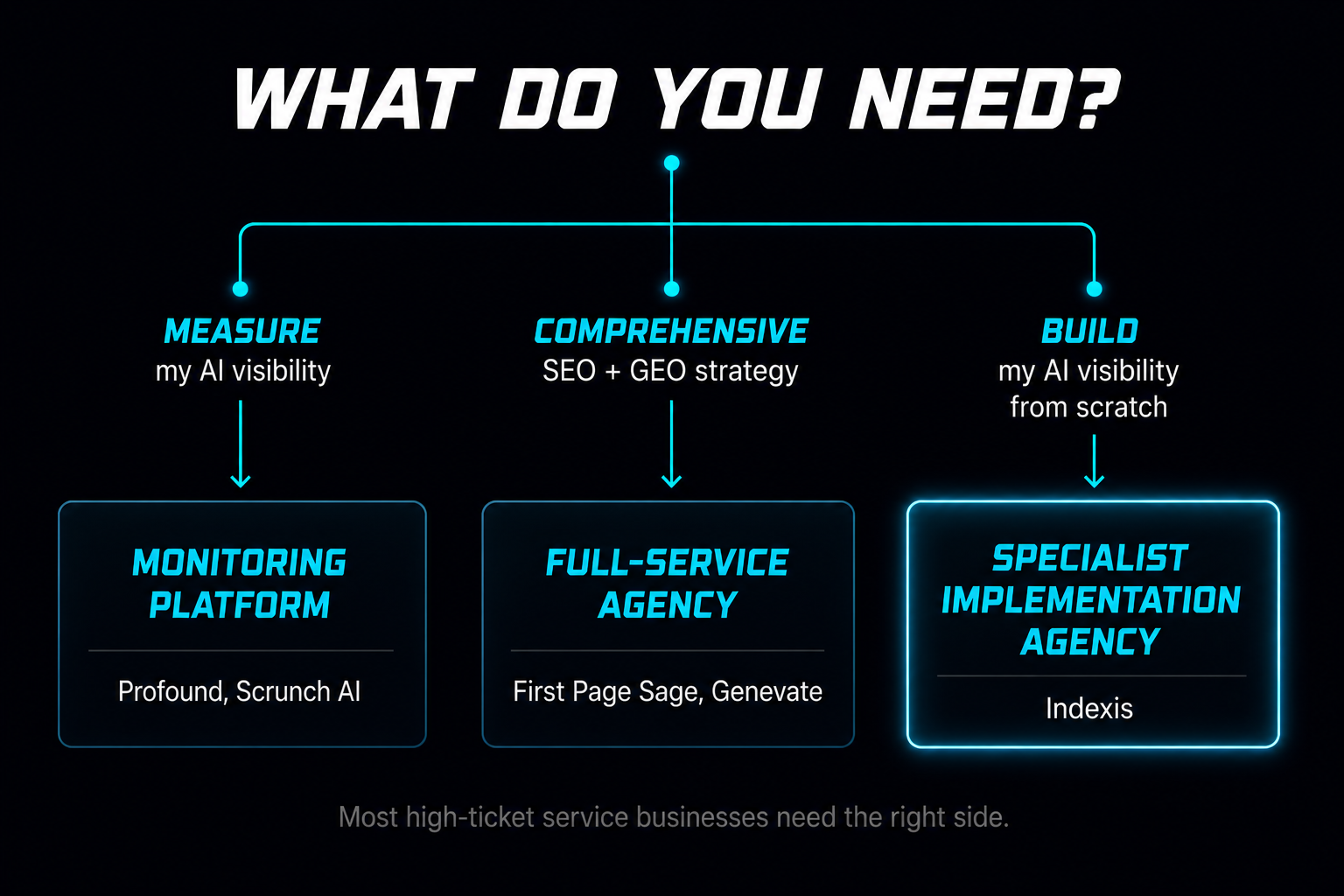
For high-ticket service businesses, coaches, consultants, and SaaS companies that need their AI visibility built from zero, the critical factor is finding a provider that does the full implementation rather than just reporting on the current state or publishing content in isolation. These businesses typically do not have in-house marketing teams capable of executing citation engineering across Reddit, forums, YouTube, third-party publications, and directories simultaneously. They need a specialist agency that will build the Schema, create the content, engineer the citations, construct the community presence, and monitor the results. The engagement model and vertical expertise matter as much as the methodology. A provider that has specifically optimized its process for coaching, consulting, or SaaS categories will deliver tighter execution than a generalist working across fifteen industries.
The GEO landscape will continue to evolve. New agencies will enter, platforms will mature, and the line between monitoring and implementation will likely blur as SaaS tools add execution features and agencies build proprietary analytics. What will not change is the underlying dynamic: AI models recommend a small number of businesses per query, and the businesses that occupy those recommendation slots are the ones that invested in building genuine AI visibility across multiple channels. The choice of provider matters less than the decision to start.
Sumedh is the founder of Indexis, a Generative Engine Optimization agency that builds full-spectrum AI visibility campaigns for high-ticket service businesses. He can be reached at getindexis.com or sumedh@getindexis.com.