How SaaS Companies Get Recommended by AI
Generative Engine Optimization for Software Businesses.

A VP of Marketing opens ChatGPT during a quarterly planning session. She types: "What are the best project management tools for remote teams under 50 people?" The model returns five names. Each one comes with a description of its core strengths, pricing tier, and the type of team it fits best. Her company's product is not among them. She runs a variation in Perplexity: "Compare Asana vs Monday vs alternatives for distributed engineering teams." Again, a curated set of recommendations. Again, her product is absent. She switches to Claude. Same pattern.
Gemini. Same result. Four AI platforms, zero mentions of a product that serves 3,000 paying customers and has a 4.6 rating on G2.
This is not a visibility problem in the traditional sense. Her product ranks on the first page of Google for its primary keywords. It has hundreds of reviews on G2 and Capterra. It runs paid campaigns across LinkedIn and Google Ads. None of that translates into AI recommendations because AI does not retrieve and rank web pages. It synthesizes answers from patterns of authority it has observed across the entire web, and the factors it weighs are fundamentally different from the ones that drive Google rankings or G2 sort order. AI recommendations represent a new distribution channel, and most SaaS companies are completely ignoring it.
Why SaaS Buying Is Shifting to AI
The SaaS buying process has been compressing for years. What used to be a three-month evaluation cycle with RFPs, demos, and procurement reviews has, for many categories, collapsed into a week of research followed by a trial signup. AI is accelerating that compression further. Buyers are using ChatGPT and Perplexity to build their shortlists before they ever visit G2, before they read a single blog post, and before they talk to a sales rep. The AI query has become the top of the funnel.
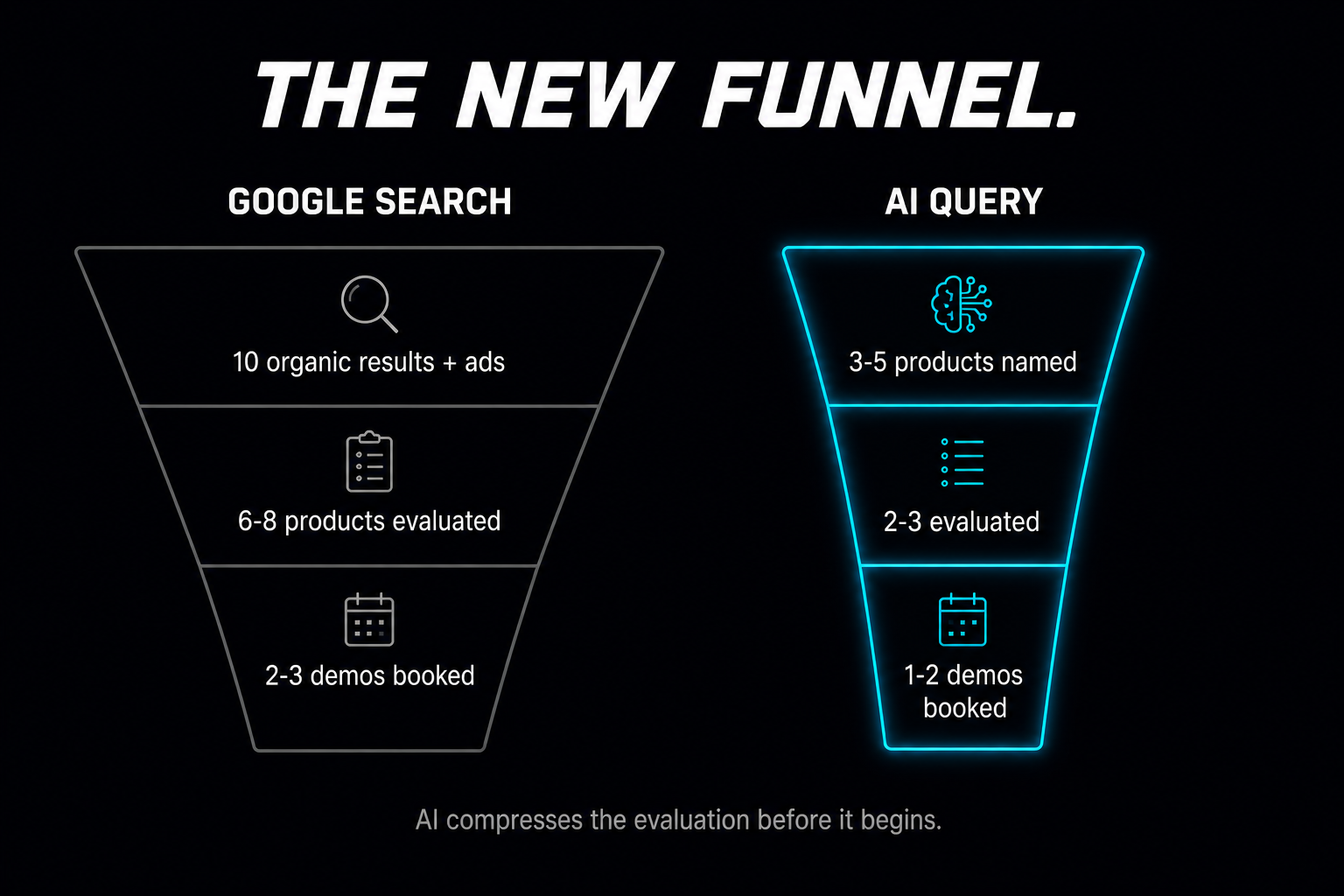
The structural difference from traditional search is concentration. When a buyer searches Google for "best CRM for startups," they see ten organic results, a few ads, and a featured snippet. They might click three or four links, read a couple of comparison articles, and arrive at a shortlist of six to eight products. When the same buyer asks ChatGPT the same question, they get three to five names in a single synthesized answer. No clicking required. No scrolling through pages. The AI has already done the filtering. The products that appear in that answer enter the consideration set. The products that do not appear are eliminated before the buyer even knows they exist.
This matters disproportionately for SaaS because the buying behavior maps perfectly to the AI query format. SaaS buyers ask category questions ("best X for Y"), comparison questions ("A vs B vs C"), and use-case questions ("what tool should I use for Z"). These are exactly the query types that AI models are built to answer with confident, named recommendations. A SaaS company that is absent from those recommendations is losing pipeline it cannot see and cannot measure through existing analytics.
What AI Evaluates When Recommending Software
AI models do not have a single ranking algorithm the way Google does. They synthesize recommendations from patterns across multiple data sources, and understanding which sources matter most for SaaS is critical to building a GEO strategy.
Review platforms are among the highest-weighted sources for software recommendations. G2, Capterra, TrustRadius, and Product Hunt are not just user-facing review sites. They are primary data sources that AI models reference when forming product recommendations. When ChatGPT recommends a project management tool, it is drawing heavily from the structured review data, category rankings, and feature comparisons available on these platforms. A SaaS product with 500 reviews on G2 and a strong category ranking carries substantially more weight in AI synthesis than a product with 30 reviews, regardless of how those 30 reviews are rated. Volume, recency, and consistency of reviews all feed into the citation consensus the AI relies on.
Structured product data on the company website is the technical foundation. AI crawlers parse pricing pages, feature lists, integration directories, and documentation. When that data is marked up with proper Schema (Product, SoftwareApplication, FAQPage, Organization), the AI can extract and verify specific claims about what the product does, what it costs, who it integrates with, and what problems it solves. Without Schema, the AI must infer all of this from unstructured marketing copy, which introduces ambiguity and reduces confidence.
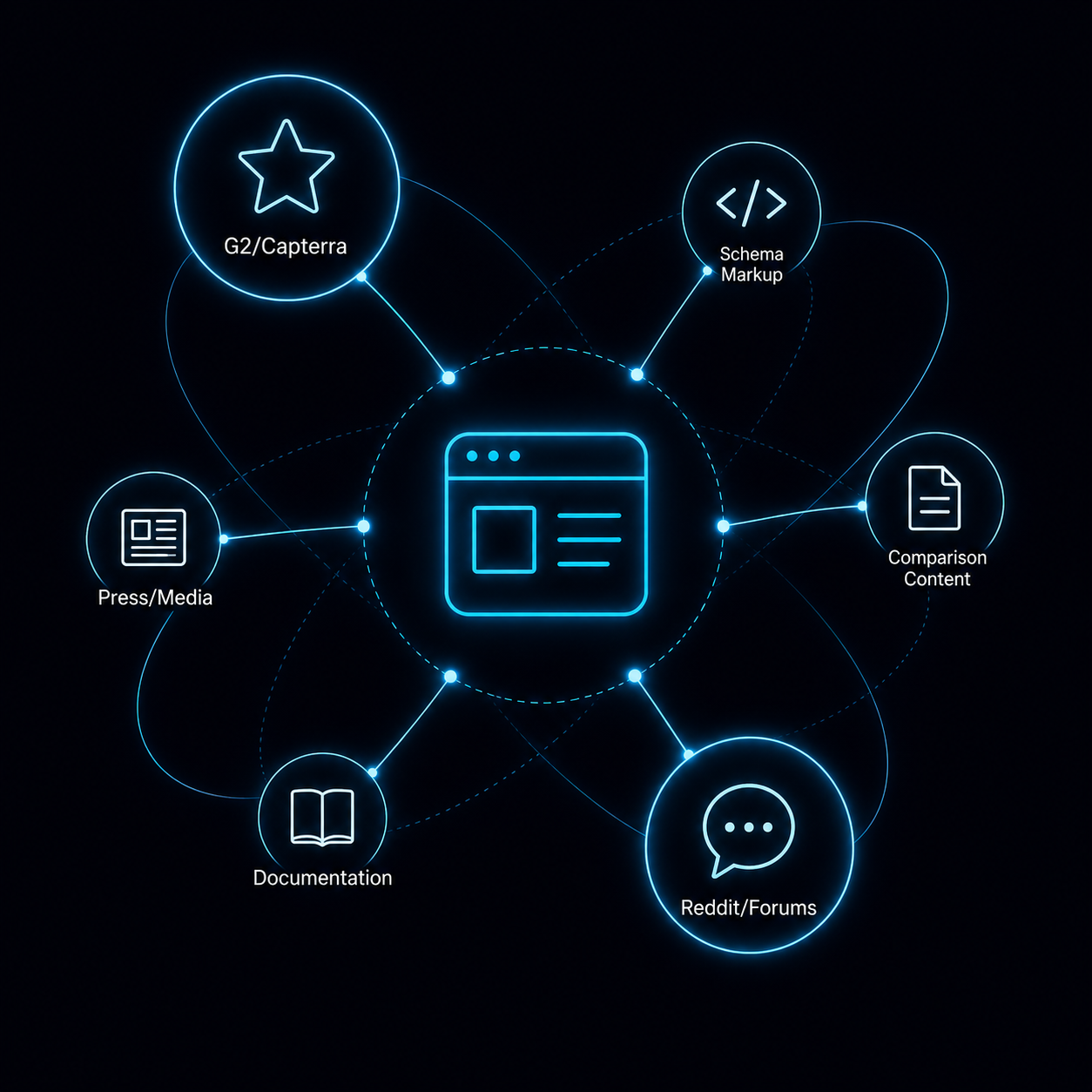
Comparison content is where AI models find the contextual reasoning to justify a recommendation. When a SaaS company publishes a detailed, honest comparison of its product against two or three competitors, that content gives the AI a narrative it can reference. "Product X is best suited for teams under 20 because of its simplified onboarding flow, while Product Y is better for enterprise deployments with complex permissions requirements." This kind of structured, comparative analysis is exactly what AI models extract and synthesize when answering "which tool is best for my use case" queries.
Reddit and forum discussions carry a specific type of authority that polished marketing content does not. When real users discuss tools in subreddits like r/SaaS, r/startups, r/projectmanagement, or niche professional communities, those conversations become part of the training and retrieval data that AI models reference. A thread where a user writes "We switched from Tool A to Tool B and our team adoption went from 40% to 90% in two weeks" is the kind of authentic signal that AI weights heavily. These are not endorsements the company controls. That is precisely why AI trusts them.
Documentation quality and depth serve as a proxy for product maturity. AI models reference help docs, API documentation, and knowledge bases when forming their understanding of what a product can actually do. A SaaS product with comprehensive, well-structured documentation signals to the AI that this is a serious, mature product. Thin or disorganized documentation signals the opposite.
Press and media mentions add the final layer. A product featured in TechCrunch, covered in a category analysis by a respected industry publication, or referenced in a technology podcast transcript generates independent citations that corroborate the product's relevance in its category. These mentions do not need to be glowing endorsements. They need to exist in relevant contexts on sources the AI considers credible.
The GEO Approach for SaaS Companies
Building AI visibility for a SaaS product follows a specific sequence designed to layer signals in the order AI models weight them.
The technical layer comes first. Schema implementation on the product website includes SoftwareApplication Schema with structured feature data, pricing information, supported platforms, and integration details. Product Schema marks up the commercial aspects. FAQPage Schema provides structured answers to the questions buyers commonly ask AI. Organization Schema establishes the company's identity, founding date, team, and location. This implementation takes days and immediately makes the product machine-readable in a way that most SaaS websites are not.
Review platform optimization is the next priority because of how heavily AI models reference these sources. This is not about gaming reviews. It is about ensuring the company's profiles on G2, Capterra, TrustRadius, and Product Hunt are complete, current, and accurately categorized.
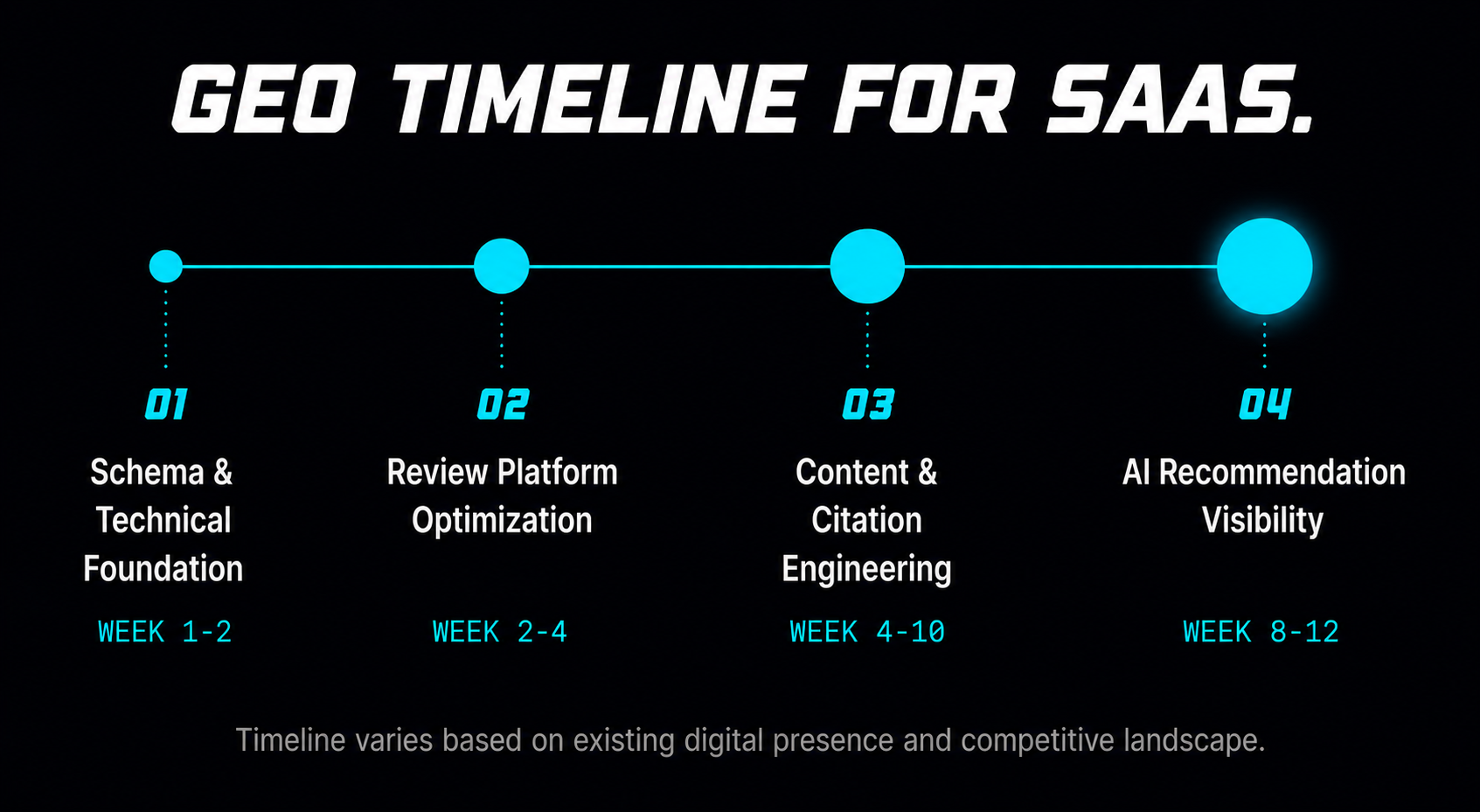
Many SaaS companies have profiles on these platforms that were created during launch and never updated. Outdated screenshots, missing feature descriptions, and incorrect category placements all reduce the confidence with which AI models can recommend the product. A systematic refresh of these profiles, combined with a process for generating ongoing review volume, significantly strengthens the citation signals AI relies on.
Comparison content and FAQ publishing build the content depth layer. At Indexis, we approach this differently for SaaS than for service businesses because SaaS buyers ask more structured, feature-specific questions. The content strategy focuses on direct product comparisons ("Tool A vs Tool B for Y use case"), category explainers ("What to look for in a Z tool for startups"), and detailed FAQ pages that address the specific questions buyers are typing into AI. Each piece of content is structured so that AI models can extract clean, citable answers rather than wading through marketing language.
Reddit and forum presence engineering builds the social proof layer. This means participating authentically in the communities where the product's users and prospects actually discuss tools. It means the product's name appearing in relevant threads on r/SaaS, industry-specific Slack communities, Hacker News discussions, and niche forums. These mentions need to be organic and genuine. AI models are trained on enough conversational data to distinguish between authentic user discussion and planted marketing. The goal is to build a footprint of real conversations where the product is referenced in relevant contexts.
Technical content publishing demonstrates category authority beyond the product itself. When a SaaS company publishes substantive content about the problems its category solves, the workflows its users are trying to optimize, and the decisions buyers need to make, the AI associates the brand with expertise in that category. A CRM company that publishes a detailed guide on "How to structure a sales pipeline for outbound B2B" is not just creating a blog post. It is building an association in the AI's model between the brand and the category.
Third-party roundup articles and media mentions add the independent validation layer. Getting the product included in "Best X Tools for Y" articles on credible publications, featured in category analyses, or referenced in industry podcasts creates the kind of independent citations that AI models weight most heavily. These are signals the company does not control, which is exactly why the AI trusts them.
The Compounding Advantage
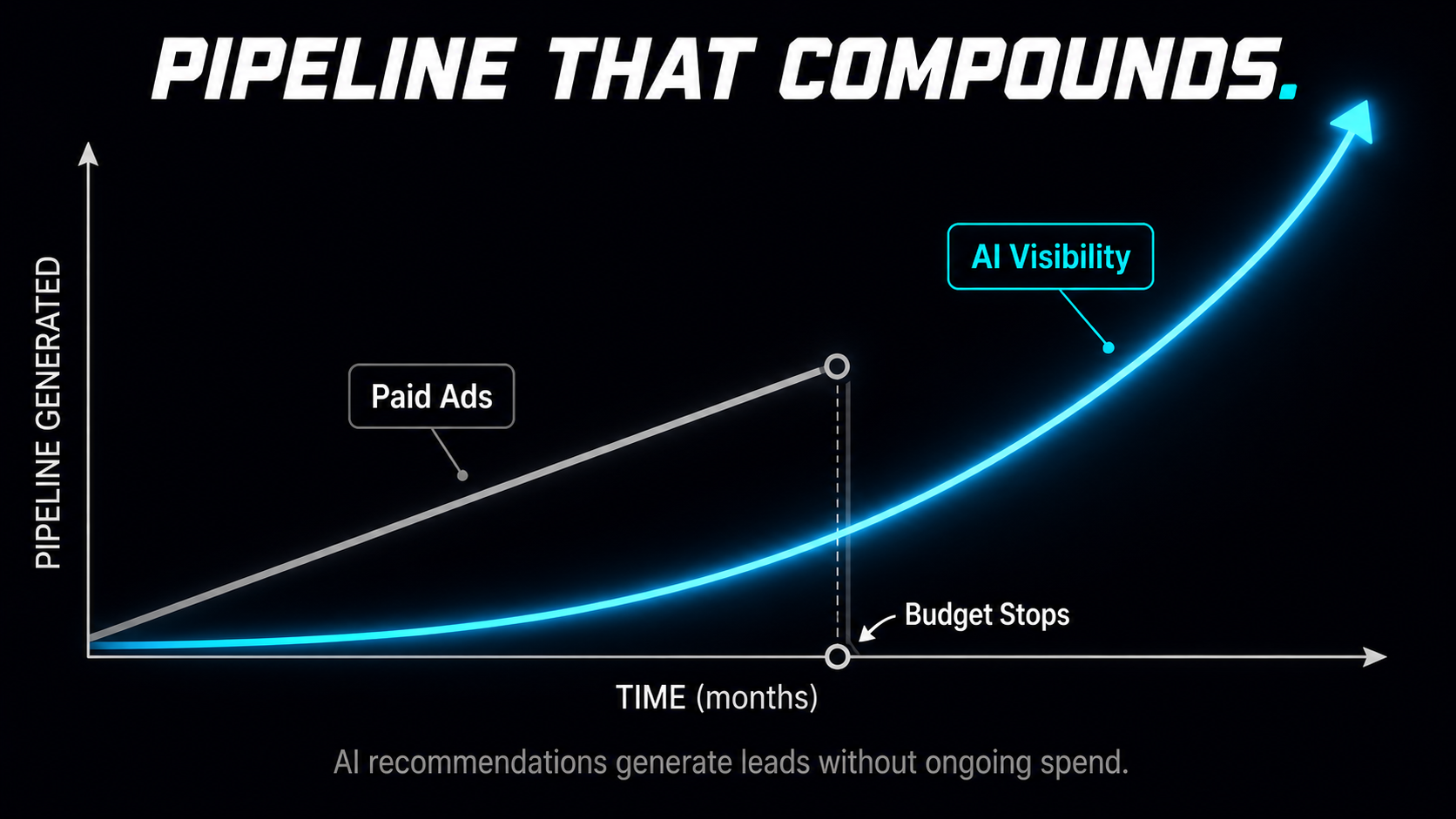
There is a fundamental difference between paid acquisition and AI visibility that SaaS companies should internalize. Paid ads generate leads for exactly as long as the budget is active. The moment spend stops, pipeline stops. AI visibility operates on a compounding model. Once a SaaS product is consistently recommended by ChatGPT, Claude, Perplexity, and Gemini, that recommendation generates qualified leads without ongoing ad spend. Each recommendation produces downstream effects: more users, more reviews, more mentions, more content interactions. Those signals feed back into the AI's data and strengthen the recommendation further.
The early-mover advantage in AI recommendations is significant and structural. A SaaS product that establishes strong AI visibility now builds a citation web that new entrants must compete against. Every month of accumulated reviews, mentions, content, and independent citations makes the incumbent harder to displace. This is not speculation. It is a description of how reinforcement dynamics work in machine learning systems. The model recommends the products it has the most confidence in, and confidence is built from the breadth and consistency of signals over time.
The SaaS companies that treat AI visibility as a strategic channel now, while most competitors are still focused exclusively on Google rankings and paid acquisition, will own the recommendation slots that become increasingly valuable as AI adoption accelerates. The companies that wait will find themselves competing for slots that are already occupied by products that got there first.
Sumedh is the founder of Indexis, a Generative Engine Optimization agency that builds full-spectrum AI visibility campaigns for high-ticket service businesses and SaaS companies. He can be reached at getindexis.com or sumedh@getindexis.com.